
 Digital EyeN
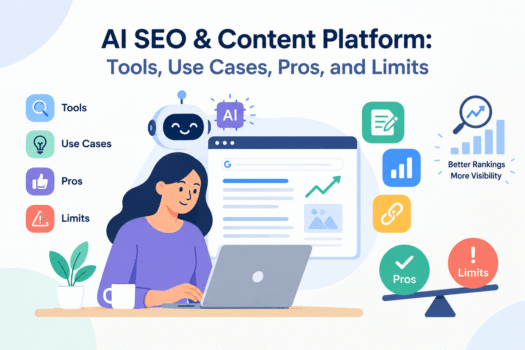
Ranking content in 2026 is not just about writing well. You need fast research, clear structure, solid on-page SEO, and content that matches what people actually want. An AI SEO & Content Platform helps with that. It can speed up keyword research, build briefs, suggest headings, improve internal links, optimize meta tags, and support content updates.
But there’s a catch. These platforms can also create plain content, repeat what already exists, or miss intent if you rely on them too much. This guide explains what an AI SEO & Content Platform does, how to choose one, which tools are worth testing, and where the limits are.
What is an AI SEO & Content Platform?
An AI SEO & Content Platform is software that combines SEO workflows (keywords, SERP analysis, on-page recommendations, internal linking, content audits) with AI-assisted content planning and writing. Some tools focus on one part (like briefs or audits). Others try to cover the full content lifecycle:
- Plan: topics, clusters, briefs, outlines, questions people ask
- Create: drafts, rewrites, tone changes, FAQs, schema suggestions
- Optimize: on-page SEO checks, missing subtopics, entities, readability
- Publish & improve: update older articles, track rankings, audit decay
Who should use an AI SEO & Content Platform?
This category is useful for:
- Content marketers managing many pages and updates
- Bloggers who want faster topic research and cleaner on-page SEO
- SEO professionals building content briefs, clusters, and audits
- Small business owners who need consistent, search-friendly copy
- Students and creators learning structure, intent, and optimization basics
Benefits of using an AI SEO & Content Platform
- Faster research: SERP patterns, common headings, “People also ask” style questions, and competitors’ content gaps.
- Better consistency: easier to follow templates for briefs, outlines, and on-page checks.
- Scalable updates: refresh older content and improve internal linking without manual review of every page.
- Clearer intent matching: many tools flag missing subtopics that top-ranking pages cover.
- Workflow support: comments, assignments, and collaboration for content teams.
Common limitations
- Generic writing risk: AI drafts can sound similar to existing SERP content.
- Fact errors: tools can produce incorrect claims or outdated info.
- Over-optimization: chasing tool scores can hurt readability and originality.
- Intent mistakes: if keywords are mixed, the tool may push the wrong angle.
- Not a ranking guarantee: links, brand, UX, topical authority, and trust still matter.
How to choose the right AI SEO & Content Platform
Use these checks before you buy:
- Workflow fit: Do you need briefs, writing, on-page scoring, audits, or all of them?
- SERP + intent analysis: Strong tools show what top pages include and why they rank.
- Collaboration: Comments, tasks, version history, and multiple users matter for teams.
- Integrations: Google Search Console, Google Docs/WordPress, and Chrome extensions help.
- Quality control: Does it support citations, source links, or fact-check workflows?
- Pricing at scale: Many tools price by “content credits” or runs. Estimate monthly output.
Practical workflow: using an AI SEO & Content Platform the right way
- Start with search intent: Identify if the keyword needs a guide, list, comparison, or tutorial.
- Build a brief: Use an SEO content brief generator to capture headings, entities, and FAQs.
- Draft in sections: Use AI for first draft, then rewrite with your own experience and examples.
- Optimize on-page: Confirm page title, H1, H2 structure, internal links, and readability.
- Add trust signals: Include author info, sources, unique screenshots, and practical steps.
- Publish and update: Use content audit and SEO automation features to refresh content that drops.
Tools related to AI SEO & Content Platform (with descriptions, features, use cases, drawbacks)
1) Surfer SEO
Surfer SEO focuses on on-page content optimization by comparing your draft to top-ranking pages. It suggests terms, headings, and structure so you can align content with what search results reward.
- Features: Content Editor, SERP Analyzer, content score, NLP/term suggestions, audit, internal linking (varies by plan).
- Use cases: Update existing posts, optimize landing pages, build outlines for writers, improve topical coverage.
- Potential drawbacks: Score-chasing can lead to keyword stuffing; can push similar structures as competitors; pricing can climb for teams.
2) Clearscope
Clearscope is a premium AI content optimization tool that helps writers cover important subtopics and terms found in top SERP content. It’s known for clean UI and strong editorial workflow.
- Features: Keyword reports, content grading, term suggestions, readability guidance, Google Docs integration (plan-dependent).
- Use cases: Editorial teams optimizing blog posts, content refresh projects, consistent brief + optimization process.
- Potential drawbacks: Higher cost than many alternatives; limited “all-in-one” SEO features compared to suite tools.
3) Semrush (Content + SEO toolkit)
Semrush is an SEO suite that includes keyword research, competitor analysis, and content marketing tools. It’s useful if you want one platform for rankings, audits, and content planning in one place.
- Features: Keyword Magic Tool, Topic Research, On Page SEO Checker, Site Audit, Position Tracking, SEO Writing Assistant.
- Use cases: Full SEO management for SMBs and agencies, content calendars, competitive gap analysis, monitoring rankings.
- Potential drawbacks: Can feel complex; some AI writing features are lighter than dedicated writing platforms; costs increase with add-ons.
4) Ahrefs (with content + audit features)
Short description (200–300 chars): Ahrefs is best known for backlinks and competitor research, but it also supports keyword research, content gap analysis, and site audits. It pairs well with a separate AI writing assistant for SEO.
- Features: Site Explorer, Keywords Explorer, Content Gap, Site Audit, rank tracking (plan dependent).
- Use cases: Find topics competitors rank for, plan clusters, diagnose technical issues affecting content performance.
- Potential drawbacks: Not a built-in writing platform; some users need another tool for briefs and drafting.
5) MarketMuse
MarketMuse is an AI-driven content strategy platform for planning clusters and improving topical authority. It helps identify content gaps and what to write next when you’re building depth in a niche.
- Features: Content inventory, topic modeling, content briefs, optimization recommendations, difficulty and opportunity scoring.
- Use cases: Content strategy for established sites, pillar/cluster planning, prioritizing updates for ROI.
- Potential drawbacks: Can be expensive; learning curve for smaller teams; may be more than you need for a small blog.
6) Frase
Frase combines SERP research, brief building, and AI drafting. It’s popular as a SEO content brief generator because it quickly pulls headings, questions, and competitors into one workspace.
- Features: SERP outline builder, question research, AI draft and rewrite, content scoring, brief templates.
- Use cases: Rapid brief creation, writing first drafts, improving coverage for informational posts.
- Potential drawbacks: AI drafts can be repetitive; on-page suggestions may need human judgment to avoid fluff.
7) Jasper (with SEO add-ons / integrations)
Jasper is an AI writing platform used for marketing copy and blog drafts. With integrations and workflows, it can act as an AI writing assistant for SEO, especially when paired with an SEO optimizer.
- Features: Brand voice, templates, long-form editor, campaign workflows, team collaboration.
- Use cases: Drafting blog content, ad copy, email sequences, rewriting and repurposing content.
- Potential drawbacks: Needs SEO data from other tools; can produce generic paragraphs without strong prompts and editing.
8) Grammarly
Grammarly improves clarity, grammar, and tone. It’s not an SEO suite, but it supports content quality, which affects engagement and trust. It’s useful alongside an AI SEO & Content Platform.
- Features: Grammar checks, clarity rewrites, tone suggestions, plagiarism checker (plans vary).
- Use cases: Final editing pass, keeping content readable, reducing mistakes on key pages.
- Potential drawbacks: Doesn’t provide keyword/intent guidance; suggestions can sometimes remove intentional style.
9) Screaming Frog SEO Spider
Screaming Frog is a technical SEO crawler that audits site structure, metadata, status codes, and internal links. It’s a strong companion for content audit and SEO automation when cleaning up old content.
- Features: Crawl diagnostics, title/meta analysis, broken links, redirects, sitemap tools, custom extraction.
- Use cases: Find thin pages, duplicate titles, missing H1s, internal linking issues, redirect chains.
- Potential drawbacks: Desktop tool with a learning curve; not focused on AI writing or content briefs.
10) Google Search Console
Google Search Console shows how your site performs in Google Search, including queries, impressions, clicks, indexing, and page experience. It’s essential for validating what your AI SEO & Content Platform suggests.
- Features: Performance reports, indexing coverage, URL inspection, sitemap submission, Core Web Vitals.
- Use cases: Find content opportunities, diagnose indexing issues, track improvements after updates.
- Potential drawbacks: No competitor data; limited keyword grouping; not a content writing tool.
11) Google Trends
Google Trends helps you understand interest over time for topics and queries. It’s useful for prioritizing seasonal content and avoiding topics that are shrinking, even if keyword tools show volume.
- Features: Trend charts, regional interest, related queries/topics, comparisons.
- Use cases: Content calendar planning, seasonal campaigns, validating topic momentum.
- Potential drawbacks: Doesn’t give exact search volume; requires interpretation; limited for deep SEO analysis.
12) WordPress (with SEO plugins like Yoast or Rank Math)
WordPress is a common publishing system for SEO content. With plugins like Yoast or Rank Math, you can control titles, meta descriptions, schema basics, and on-page checks, working alongside AI-generated drafts.
- Features: Publishing workflow, categories/tags, SEO plugin integration, redirects (plugin), schema (plugin), editorial tools.
- Use cases: Publishing SEO blogs, managing internal links, improving on-page structure, fast updates.
- Potential drawbacks: Plugin suggestions can be simplistic; site speed depends on hosting and plugin bloat; needs maintenance.
Future trends for AI SEO & Content Platforms
- Stronger content auditing: More tools will automate decay detection and suggest refresh priorities.
- Entity-based optimization: Less focus on keywords alone, more on topics, entities, and relationships.
- Better citation workflows: Expect more “source-first” drafting and claim checking.
- Omni-channel reuse: One brief feeding blog, newsletter, short video script, and social posts.
- Personalization: Content suggestions tied to CRM, audience segments, and funnel stage.
Frequently Asked Questions
1. What is an AI SEO & Content Platform?
It’s a tool that helps plan, draft, optimize, and update content for SEO using AI plus SERP and keyword data.
2. Can an AI SEO & Content Platform guarantee rankings?
No. It can improve quality and speed, but rankings still depend on competition, links, site health, and trust signals.
3. Is an AI SEO & Content Platform safe for business websites?
Yes, if you edit carefully, fact-check claims, and keep a consistent brand voice. Avoid publishing unreviewed drafts.
4. What’s the best AI keyword research tool for beginners?
Semrush is beginner-friendly as a suite, while Google Search Console is essential for your own site data.
5. How does an AI content optimization tool help?
It highlights missing subtopics, terms, and structure patterns from top-ranking pages so your content is more complete.
6. What should a SEO content brief generator include?
Primary intent, target audience, headline angle, H2/H3 outline, key questions, internal links to add, and sources to cite.
7. Are AI writing assistants for SEO good for product pages?
They can help with structure and clarity, but you should add real product details, specs, and proof to avoid generic copy.
8. How often should I run content audit and SEO automation?
For active sites, monthly is a good baseline. For larger sites, run continuous tracking with quarterly deep audits.
In closing, AI SEO & Content Platform can save hours each week, especially for research, briefs, optimization, and updates. The best results happen when you treat AI as a support layer, not a replacement for expertise. Pick a tool that matches your workflow, validate ideas in Search Console, and publish content that adds something real.